|
Human Rights in Focus - Quarterly Update ͏ ͏ ͏ ͏ ͏ ͏ ͏ ͏ ͏ ͏ ͏ ͏ ͏ ͏ ͏ ͏ ͏ ͏ ͏ ͏ ͏ ͏ ͏ ͏ ͏ ͏ ͏ ͏ ͏ ͏ ͏ ͏ ͏ ͏ ͏ ͏ ͏ ͏ ͏ ͏ ͏ ͏ ͏ ͏ ͏ ͏ ͏ ͏ ͏ ͏ ͏ ͏ ͏ ͏ ͏ ͏ ͏ ͏ ͏ ͏ ͏ ͏ ͏ ͏ ͏ ͏ ͏ ͏ ͏ ͏ ͏ ͏ ͏ ͏ ͏ ͏ ͏ ͏ ͏ ͏ ͏ ͏ ͏ ͏ ͏ ͏ ͏ ͏ ͏ ͏ ͏ ͏ ͏ ͏ ͏ ͏ ͏ ͏ ͏ ͏ ͏ ͏ ͏ ͏ ͏ ͏ ͏ ͏ ͏ ͏ ͏ ͏ ͏ ͏ ͏ ͏ ͏ ͏ ͏ ͏ ͏ ͏ ͏ ͏ ͏ ͏ ͏ ͏ ͏ ͏ ͏ ͏ ͏ ͏ ͏ ͏ ͏ ͏ ͏ ͏ ͏ ͏ ͏ ͏ ͏ ͏ ͏ ͏ ͏ ͏ ͏ ͏ ͏ ͏ ͏ ͏ ͏ ͏ ͏ ͏ ͏ ͏ ͏ ͏ ͏ ͏ ͏ ͏ ͏ ͏ ͏ ͏ ͏ ͏ ͏ ͏ ͏ ͏ ͏ ͏ ͏ ͏ ͏ ͏ ͏ ͏ ͏ ͏ ͏ ͏ ͏ ͏ ͏ ͏ ͏ ͏ ͏ ͏ ͏ ͏ ͏ ͏ ͏ ͏ ͏ ͏ ͏ ͏ ͏ ͏ ͏ ͏ ͏ ͏ ͏ ͏ ͏ ͏ ͏ ͏ ͏ ͏ ͏ ͏ ͏ ͏ ͏ ͏ ͏ ͏ ͏ ͏ ͏ ͏ ͏ ͏ ͏ ͏ ͏ ͏ ͏ ͏ ͏ ͏ ͏ ͏ ͏ ͏ ͏ ͏ ͏ ͏ ͏ ͏ ͏
The EU-VALUES Newsletter Issue 5
|
Human Rights and EU Research – Latest Developments and Insights
|
|
Human rights are under the spotlight in Europe and beyond, spurring new laws and academic research. The European Union has recently taken bold steps – for example, adopting a landmark directive in 2024 that requires companies to perform human rights and environmental due diligence. At the same time, global conflicts and overlapping crises (from pandemics and war to attacks on the rule of law) have intensified debates about fundamental rights. This newsletter provides an overview of recent developments, highlighting key publications and projects that shed light on how human rights are being protected and promoted through EU initiatives and research.
|
|
|
What does a second Trump presidency mean for Europe and the global order? In this EU-VALUES Talks episode, Prof. Javier Solana explores the EU’s response to rising geopolitical uncertainty, shifting alliances, and strategic autonomy. A must-watch on democracy, diplomacy, and the future of Europe’s role in a changing world. |
|
Corporations and Human Rights
|
|
In 2024, the EU formally adopted the Corporate Sustainability Due Diligence Directive (CSDDD), obliging companies to prevent human rights abuses and environmental harm in their global value chains. This directive, subject to ongoing revisions, aims to close governance gaps by holding corporations accountable for their impacts abroad.
A recent article by Almut Schilling-Vacaflor and Andrea Lenschow analyzes these policy changes, finding that the new EU rules are more comprehensive than previous supply-chain regulations but still face contested design choices. They argue that truly strengthening corporate accountability will require tackling persistent challenges – such as the weak enforcement of reporting obligations, limited stakeholder input from the Global South, poor state monitoring, and difficulties in establishing legal liability for harms. Similar conclusions were reached by Axel Marx who compared the institutional design of the CSDDD to nine other due diligence measures focusing on monitoring and sanctioning provisions. A complementary angle comes from Kari Otteburn’s latest study on access to remedies for corporate human rights abuse. Her article examines the OECD’s National Contact Points (NCPs) – grievance mechanisms where victims can file complaints under the OECD Guidelines for Multinational Enterprises. Overall, Otteburn’s research underscores that the design of accountability mechanisms matters: even voluntary frameworks can yield results if structured to empower complainants and ensure follow-through on findings.
Broadening the view, a new book chapter by Humberto Cantú Rivera highlights how human rights duties for corporations are emerging in international and regional law. Focusing on the Inter-American human rights system, the research shows that regional bodies have increasingly pressed states to ensure businesses respect human rights – essentially requiring governments to exercise due diligence so that private companies do not violate individuals’ rights. This development, in the Inter-American Court of Human Rights and beyond, points to a converging trend: around the world, the expectation is growing that companies must not only refrain from abuse but also proactively account for human rights, under the watch of both national authorities and international norms. Such scholarship situates Europe’s efforts (like the CSDDD) within a larger movement to hold corporations accountable across borders.
|
|
Researchers are warning that the current geopolitical climate is putting human rights under strain. In Globalisation, Human Rights and Education, editor Joseph Zajda and colleagues analyze how neo-liberal globalization and corporate influences are reshaping discourses of equality and rights. Schools and universities, pressured to adopt business-like efficiency and metrics, may sideline critical discussions of social justice and human dignity. The book calls for urgent reflection on these challenges, arguing that we must critically examine how dominant ideologies and power structures affect human rights education and advocacy.
Meanwhile, within Europe, a series of overlapping crises has raised alarms about the erosion of rights. Xavier Groussot and Alezini Loxa, in their chapter Fundamental Social Rights and the EU Charter in Times of Crisis, describe Europe’s current situation as a “poly-crisis.” Over the past decade, EU member states have weathered an economic downturn, a migration surge, a pandemic, and now a war at the Union’s borders and a rule-of-law showdown in some countries. These multiple shocks have made emergency measures and crisis-driven policies increasingly the norm. Groussot and Loxa explore how this environment has impacted social rights (like labor protections and welfare) under the EU Charter of Fundamental Rights.
|
Book Presentation: National Human Rights Institutions in Europe and Latin America
|
|
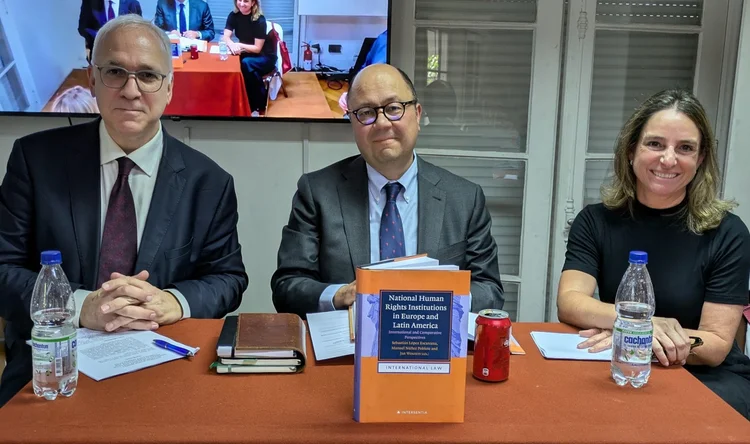
A highlight of recent scholarship is the book National Human Rights Institutions in Europe and Latin America: International and Comparative Perspectives. This volume, edited by Manuel Núñez Poblete, Sebastian López Escarcena and Jan Wouters, was formally presented at the first EU-VALUES International Conference in Santiago de Chile, in December 2024. The book showcases critical research on National Human Rights Institutions (NHRIs) – bodies like ombuds offices and human rights commissions – and their growing role in governance.
What makes this publication unique is its bridge between two regions: it directly compares NHRI experiences in Europe and Latin America. Chapters examine how NHRIs interact with the United Nations, the European Union, and the Inter-American Court of Human Rights, and they delve into case studies from Spain, France, Chile, and beyond. By placing European and Latin American perspectives side by side, the editors fill a gap in the literature and highlight how lessons learned in one context can inform the other.
The launch event in Santiago de Chile brought together the editors of the book with practitioners like Beatriz Corbo (of Chile’s NHRI) to discuss these insights. The consensus was that strong, independent NHRIs are crucial in holding governments accountable and protecting citizens’ rights – a theme that resonates in both regions. For readers, this book offers a wealth of comparative knowledge on how to empower national institutions as champions of human rights.
|
|
Beyond publications, several ongoing projects in the EU research landscape are advancing our understanding of human rights in innovative ways. Here we spotlight three initiatives:
|
|
1. FRIDA: The Future of Human Rights in a Digitised Age Referred to by the acronym FRIDA, the Future of Human Rights in a Digitised Age project examines what human rights mean in an era of ubiquitous digital technology. Led by Prof. Lena Halldenius at Lund University, the research focuses on people who are digitally excluded – those who, by choice or circumstance, live offline in an increasingly online world. Indeed, while much policy attention has been given to a ‘right to Internet access’, FRIDA flips the question: what rights do individuals have when they cannot or do not engage with digital society? The project combines philosophy and fieldwork, using ethnographic methods in the city of Malmö to understand the lived experiences of digitally marginalized groups. Over the next three years, researchers will work closely with participants to document challenges and develop a new theoretical framework for human rights suited to the digital age. By addressing issues like access to public services, privacy, and freedom of choice in a high-tech environment, this project aims to ensure that the rush to digitize does not leave vulnerable populations behind. 2. CERTO: Charter Education and European Rights Training Online 2025 marks the 25th anniversary of the Charter of Fundamental Rights of the European Union—one of the Union’s most important legal instruments, yet still relatively unknown across many of its Member States. To commemorate this occasion and strengthen awareness of the Charter’s relevance in national as well as EU law and policymaking, KU Leuven is coordinating the CERTO project: Charter Education and European Rights Training Online. Funded by the European Commission’s DG JUST, CERTO is led by the Leuven Centre for Global Governance Studies. The project brings together leading experts and academic institutions to develop a series of accessible online courses and a comprehensive training manual. These resources are designed to guide legal and policy professionals in Member States and EU institutions in applying the Charter effectively, particularly in the context of legislative drafting and compliance checks. The course is set to launch next year on the EU Academy Platform. 3. Mediate
New EU rules, based on the notion of due diligence, redefine corporate responsibilities for human rights and environmental protection. Mediate explores how intermediary actors help translate due diligence into practice, with an eye on equitable outcomes for SMEs and small-scale producers in the Global South. The Mediate project examines four central questions around the role of intermediaries in complying with and shaping new sustainability rules. 1. What are the new rules? Mediate maps out which due diligence obligations are emerging, including in public procurement and the financial sector.
2. Who helps companies? Mediate examines what types of intermediaries (such as labels, consultants, NGOs) are active and how they support companies in due diligence.
3. What is the impact in practice? Mediate looks at how the use of these intermediaries affects due diligence processes and what that means for smaller companies and producers, especially in the Global South.
4. What do we learn from intermediaries? Mediate develops new theoretical insights into how intermediaries work together and how they contribute to international sustainability policies. Although the focus of the Mediate project is not limited to one specific sector, food chains have a central place in empirical research. The project puts its focus on how intermediary organisations can play a key role in due diligence processes. This includes analysing the support offered by existing legislation, developing practical tools and guidelines (e.g., toolkit, policy briefs, training modules) and strengthening their contribution to sustainability. In addition, the project facilitates cooperation and dialogue among these organisations to increase their impact and make the food sector more sustainable. The project is funded by the Flemish Scientific Research Fund and is co-led by EU-VALUES network partner Leuven Centre for Global Governance Studies. The project will run for four years.
|
Network Roundup from the Last Quarter:
|
|
Explore the latest ideas and insights from the EU-VALUES Network on our blog! Over the past quarter, our blogs have explored critical topics at the intersection of politics, democracy, and international relations, including:
|
|
|
Lessons for Finland’s updated Integration Act: Finland’s new policy marks a shift from mutual adaptation to individual responsibility, reflecting a broader EU trend toward assimilation. Researcher Dionysia Kang reveals how this shift entrenches migrant precarity and raises urgent questions about the EU’s commitment to equality, inclusion, and human dignity. |
|
🎙️ The European Dialogue Podcast:
Listen now on Spotify, YouTube, or SoundCloud
|
EU-VALUES Webinar Series 📺
|
|
Our latest webinars are now available to watch on-demand. If you found the discussions insightful, we’d love for you to share them with your networks to help us broaden the conversation! You can see all episodes on our website and Youtube: Democracy’s Resilience to Populism’s Threat Prof. Kurt Weyland (UT-Austin) challenges assumptions about populism’s inevitability in weakening democracy, drawing on case studies from Latin America and Europe. Dr. Adam Holesch (IBEI) adds a critical perspective on how institutional strength and democratic norms can counter populist pressures. Human Rights, Climate Change & Plastic Pollution: Planetary Justice in Focus In this thought-provoking session, Dr. Sam Varvastian (Cardiff University) discusses human rights approaches to environmental crises, while Prof. Sara Seck (Dalhousie University) explores corporate accountability and legal frameworks for justice in the Anthropocene. Democracy Despite Itself: Liberal Constitutionalism and Militant Democracy. Prof. Benjamin Schupmann (Yale-NUS College) unpacks key arguments from his book, exploring how liberal democracies can defend themselves against illiberal threats. Dr. Tom Theuns (Leiden University) offers reflections on the book’s relevance to Europe’s democratic backsliding and populist challenges.
|
What’s Coming Up Next for the EU-VALUES Network?
|
|

|
Stay Tuned for our next EU-VALUES Conference - Coming to Istanbul in July 2025!
We are heading to Istanbul for our Conference on the EU’s External Action, hosted by Sabanci University. Scholars and practitioners will discuss human rights, contestation and compliance in EU policy. Look forward to seeing some of you there! |
|
|
|
Thank you to Dr. Philip De Man and Dr. Axel Marx of Leuven Centre for Global Governance Studies (KU Leuven) for their contributions to this issue.
|
|
All rights reserved. Copyright © 2024 EU-VALUES.
Erasmus+ Programme. Jean Monnet Networks. Grant number: 101127854.
Our mailing address is euvalues@ibei.org.
|
|
|
|