|
EU-VALUES Network: EU Trade and Human Rights in Focus ͏ ͏ ͏ ͏ ͏ ͏ ͏ ͏ ͏ ͏ ͏ ͏ ͏ ͏ ͏ ͏ ͏ ͏ ͏ ͏ ͏ ͏ ͏ ͏ ͏ ͏ ͏ ͏ ͏ ͏ ͏ ͏ ͏ ͏ ͏ ͏ ͏ ͏ ͏ ͏ ͏ ͏ ͏ ͏ ͏ ͏ ͏ ͏ ͏ ͏ ͏ ͏ ͏ ͏ ͏ ͏ ͏ ͏ ͏ ͏ ͏ ͏ ͏ ͏ ͏ ͏ ͏ ͏ ͏ ͏ ͏ ͏ ͏ ͏ ͏ ͏ ͏ ͏ ͏ ͏ ͏ ͏ ͏ ͏ ͏ ͏ ͏ ͏ ͏ ͏ ͏ ͏ ͏ ͏ ͏ ͏ ͏ ͏ ͏ ͏ ͏ ͏ ͏ ͏ ͏ ͏ ͏ ͏ ͏ ͏ ͏ ͏ ͏ ͏ ͏ ͏ ͏ ͏ ͏ ͏ ͏ ͏ ͏ ͏ ͏ ͏ ͏ ͏ ͏ ͏ ͏ ͏ ͏ ͏ ͏ ͏ ͏ ͏ ͏ ͏ ͏ ͏ ͏ ͏ ͏ ͏ ͏ ͏ ͏ ͏ ͏ ͏ ͏ ͏ ͏ ͏ ͏ ͏ ͏ ͏ ͏ ͏ ͏ ͏ ͏ ͏ ͏ ͏ ͏ ͏ ͏ ͏ ͏ ͏ ͏ ͏ ͏ ͏ ͏ ͏ ͏ ͏ ͏ ͏ ͏ ͏ ͏ ͏ ͏ ͏ ͏ ͏ ͏ ͏ ͏ ͏ ͏ ͏ ͏ ͏ ͏ ͏ ͏ ͏ ͏ ͏ ͏ ͏ ͏ ͏ ͏ ͏ ͏ ͏ ͏ ͏ ͏ ͏ ͏ ͏ ͏ ͏ ͏ ͏ ͏ ͏ ͏ ͏ ͏ ͏ ͏ ͏ ͏ ͏ ͏ ͏ ͏ ͏ ͏ ͏ ͏ ͏ ͏ ͏ ͏ ͏ ͏ ͏ ͏ ͏ ͏ ͏ ͏ ͏ ͏
The EU-VALUES Newsletter Issue 6
|
Human Rights and Trade: Achievements, Challenges & Future DirectionsHow does EU trade policy shape the protection of human rights around the world? This issue takes a closer look at the intersections between commerce and rights, asking where progress has been made, what barriers remain, and how partner institutions contribute to this evolving agenda. Building on the foundation of the Corporate Sustainability Due Diligence Directive (CS3D / CSDDD), we explore how regulation and trade combine—and sometimes collide—in embedding human rights at the core of European policy. Trade and human rights is a fraught terrain: while European trade agreements increasingly include labour, sustainability, and human-rights chapters (or side instruments), enforcement remains weak, and many structural tensions remain unresolved. The EU also employs conditionality in its Generalised Scheme of Preferences (GSP) and uses trade policy as a lever of normative power. In this edition, we start by highlighting the EU-VALUES international conference held in Istanbul (30 June – 2 July 2025), focusing especially on panels that addressed trade and human rights. Then, we present recent publications, projects, and events such as the Euro-Asia Summer School 2025, and critically reflect on both achievements and challenges in aligning trade and rights.
|
Spotlight: EU-VALUES Conference, Istanbul 2025 – Trade & Human Rights in Focus
|
|
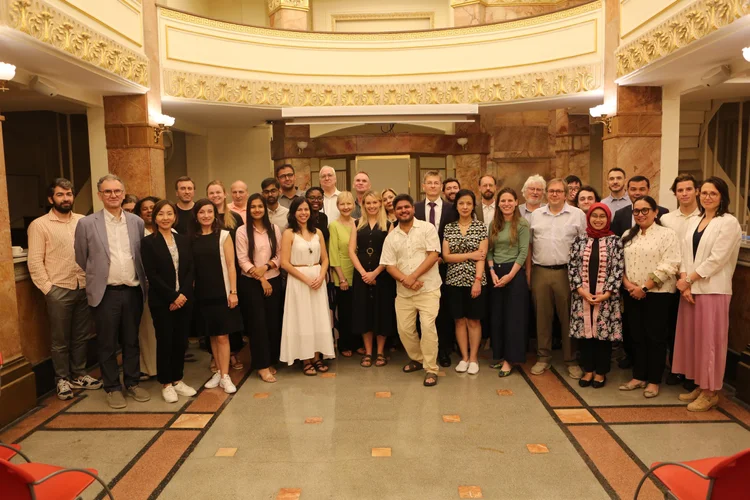
The EU-VALUES International Conference, hosted by Sabancı University / Istanbul Policy Center in late June – early July 2025, convened around 65 scholars and policy actors from 16 countries to examine the EU’s external action through the prism of values and rights. Although the conference covered a broad range of themes (democracy, youth, migration, digital governance), the trade–human rights nexus featured prominently, especially in Panel I and Panel VI of the program.
|
|
First, ‘Panel I: Human Rights and EU External Action’ included a presentation by Axel Marx (KU Leuven / Leuven Leuven Centre for Global Governance Studies) titled “Strengthening the Implementation and Monitoring of Labour Rights Commitments in EU Free Trade Agreements: What Role for Roadmaps?”. Marx examined practical mechanisms such as roadmaps that might enhance compliance with labour rights obligations in EU trade treaties. Panel VI was dedicated to ‘Human Rights, Trade, and Border Governance’. In this panel, presenters explored how trade and human rights pressures intersect at external borders and in supply chains, including analyses of civil society responses to border crises and the role of climate-related rights in external action. The conference closing reflections, led by EU-VALUES coordinators and keynote speakers, emphasized the tension between rhetorical commitment and concrete coherence across trade, development, and human rights agendas. As such, the Istanbul conference underscored that while trade policy is now frequently framed in normative terms, many crucial questions remain about accountability, instrument design, and geopolitical constraints. A fuller conference summary is available on the EU-VALUES website, and an in depth Reflection Paper here.
|
|
|
|
Lee Jaemin also co-authored an article with Park Ryugyung (William & Mary) in the August 2025 issue of the Journal of World Trade journal on Greening WTO: A Lost Cause or Potential Solution? In this article, the authors explore how the World Trade Organization could integrate climate and human rights objectives. The article argues that while WTO dispute settlement has traditionally separated trade and non-trade issues, environmental and labour concerns are increasingly unavoidable. It analyzes historical cases and proposes ways the WTO might evolve to support “green” trade policies without breaching its core mandates. |
|
|
|
|

|
Complementing this perspective, Michelle Egan’s (American University) The Values-Based Trade Agenda (NYU Journal of Law & Public Policy, 2023) argues that transatlantic regulatory cooperation should move beyond a narrow focus on efficiency to explicitly embed equity, fairness, and human rights, raising the critical question of whether trade agreements can ever be genuinely “values-based” rather than rhetorical exercises. |
|
|
|
Finally, we can highlight the KU Leuven Consumer Competition Market Blog and its focus on due diligence in EU trade policy. Estelle Valentine Irambona’s (KUL) post: A closer look at the corporate due diligence duty under the CS3D (Part 1) (August 2024) offers a detailed overview of the substantive obligations introduced by the EU’s Corporate Sustainability Due Diligence Directive, highlighting companies’ duties to identify, prevent, and mitigate human rights and environmental harms across their operations and supply chains. In a follow-up piece, The extraterritorial dimensions of the CS3D (Part 2) (October 2024), Irambona extends the analysis to the Directive’s external reach, showing how its requirements affect overseas subsidiaries and suppliers, and even non-EU companies active in the internal market. While the EU cannot directly legislate abroad, the post argues, the CS3D’s indirect extraterritorial impact may exert pressure on third countries to elevate their human rights standards.
|
Academic Projects & Initiatives
|
|
Two research projects within the EU-VALUES network illustrate how trade, human rights, and corporate accountability are being investigated from complementary perspectives: “Mediate: Moderating due diligence through intermediary engagement” (KU Leuven, HIVA, 2023–26) examines how companies implement human-rights due diligence in global value chains, focusing on the underexplored role of intermediaries—such as auditors, certifiers, consultants, trade unions, and NGOs—in shaping compliance. The project seeks to identify how these actors facilitate or hinder the fulfilment of EU due-diligence requirements and to develop practical tools for more effective corporate accountability. “Implications of mandatory due diligence regulations in global agrifood supply chains” (Leuven Centre for Global Governance Studies, 2024) investigates the impact of EU regulations, such as the Deforestation Regulation, on agricultural trade in commodities like soy and palm oil. By modelling firms’ responses to new obligations and assessing effects on farmers and trade flows, the project critically evaluates how due-diligence mandates influence both market dynamics and the protection of human rights and environmental standards.
The Istanbul Policy Center (IPC) continued to foreground themes of governance, values, and external relations in its 2024 programming. Its 2024 Activity Report list several activities that intersect directly with debates on human rights and trade. Events such as the keynote by Christoph Böhringer (Carl von Ossietzky University) on “Potential Impacts and Challenges of Border Carbon Adjustments” (March 2024) and the workshop “Just Transition: Insights from Various Phases of the Coal Transition” (October 2024) linked climate policy tools with questions of distributive justice in global trade regimes. IPC also launched the EU-funded project Promoting Just Transition in Turkey (2023–24), which examined how decarbonization policies affect local communities and contribute to equitable participation in energy transitions—a theme closely tied to the EU’s value-based trade agenda.
In addition, IPC’s analyses of EU-Turkey relations in light of Hungary’s EU presidency (September 2024) and the Istanbul Convention (November 2024) underscore how broader human rights and governance commitments shape economic and diplomatic ties. Collectively, these initiatives highlight IPC’s role in situating Turkey within debates on normative conditionality, climate justice, and the social dimensions of trade policy.
|
Event Highlight: Euro-Asia Summer School 2025 -Trade, Values & EU External Projection
|
|
The Euro-Asia Summer School 2025 jointly organized with the Institut Barcelona Estudis Internacionals (IBEI), Hitotsubashi University, KU Leuven, and Seoul National University, opened in Asia (25–29 August) with a keynote by the former Ambassador of Japan to the EU. The programme featured lectures and discussions on peacebuilding in conflict zones, democracy, migration, nuclear security, and the role of soft power in Europe and Asia, complemented by a cultural field trip in Tokyo that engaged students with Japan’s history, society, and contemporary challenges. The Summer School then moved to Europe, with a European week in Barcelona with a programme that included several lectures explicitly engaging with the EU’s normative ambitions in trade and human rights. The programme opened with Jacint Jordana (IBEI) on “EU Values and European Foreign Policy,” followed by Philip de Man’s (KUL) reflections on global commons in “Commons or Commodity?” and his later lecture on the Responsibility to Protect. Kari Otteburn (KUL) contributed two sessions, “The EU and Global Trade Governance: Between Values and Interests in Geopolitical Times” and “Fitting Values into Strategic Autonomy: The EU in the Promotion of Human and Labour Rights Beyond Borders,” both of which probed the EU’s ability to advance normative trade and human rights agendas under geopolitical constraints. Further perspectives came from Raquel Bouso (Universitat Pompeu Fabra) on Asian and European values, Juan Díez Medrano (Universidad Carlos III Madrid) on comparing global value systems, and Adam Holesch (IBEI) on the EU and democracy. Diego Badell (IBEI) addressed gender and authoritarian populism across regions, while Elisabeth Johansson-Nogués (IBEI) analysed the EU’s security and defence role in Asia. Yannis Karagiannis (IBEI) examined the EU’s regulatory influence in Asia, and Catherine De Vries (Bocconi University) concluded the week with a lecture on public service deprivation and the rise of the far right in Europe. Together, these contributions underscored the opportunities and limits of the EU’s ambition to project values through its trade, security, and foreign policy instruments.
|
Network Roundup from the Last Quarter:
|
|
Corporate accountability in global value chains is gaining urgency as human rights abuses and environmental harms persist across borders. Elena Dzneladze (KUL) examines how new due diligence laws are reshaping business responsibilities and the EU’s role in setting global standards. |
|
|
|
|
|
|
Explore the latest ideas and insights from the EU-VALUES Network on our blog! Over the past quarter, our blogs have explored critical topics at the intersection of politics, democracy, and international relations. In addition to Elena’s piece above, check out:
|
EU-VALUES Talks: Universal Values, Democracy and Nonviolence with Ramin Jahanbegloo 🎥
|
|
|
What are the foundations of democracy, and how can societies protect them in times of cultural and political tension? In this EU-VALUES Talks episode, philosopher and public intellectual Ramin Jahanbegloo reflects on universal values, cultural traditions, and the enduring power of nonviolence. Ramin is affiliated with O.P. Jindal Global University (JGU) and the University of Toronto. |
|
New on the European Dialogue Podcast:
|
|
|

|
EU Corporate Due Diligence: Finding the Smart Mix: Radu Mares (Lund University) examines how the European Green Deal reshapes global supply chains, testing Europe’s balance between regulatory ambition, fairness, and cooperation. |
|
|
|
From Backsliding to Building: Philanthropy’s Role in Europe’s Democratic Crisis: Sevda Kilicalp and Nils Luyten (PHILEA) discuss how philanthropy can counter subtle forms of democratic backsliding, strengthen civic space, and rebuild trust in institutions. |
|

|
|
|
|
|

|
Who Leads in Cyberspace? Democratic Values and the EU–US Digital Future: Elaine Fahey (City St. George’s, University of London) explores whether shared democratic values can anchor EU–US cooperation on cybersecurity, AI, and the governance of the digital future. |
|
|
|
Catch up on EU-VALUES WebinarsOur most recent EU-VALUES Network webinars are now available to stream anytime. If you find these conversations valuable, please share them with your networks! You can watch all episodes on our website and YouTube. Two of our recent favourites included:
|
What’s Coming Up Next for the EU-VALUES Network?
|
|
|
|