
The War in Ukraine and War Fatigue in Europe
Since the escalation of Russia’s war against Ukraine, the European political order has entered a phase of realignment. In the immediate aftermath of the full-scale invasion in February 2022, Europe’s response suggested a level of resolve that many observers had not anticipated. Support for Ukraine was strong, if uneven, across the continent, translating into sanctions, military assistance, and sustained diplomatic backing.
Nearly four years later, the context looks markedly different. The war has become protracted, its costs increasingly visible, and its outcome more uncertain. Energy prices surged across Europe, contributing to high inflation, while renewed Russian advances on the battlefield have dampened expectations of a swift Ukrainian success. Against this backdrop, questions have emerged in many countries about how long support for Ukraine can be sustained. While these doubts are frequently voiced in public debate, systematic evidence on whether “war support fatigue” is actually taking hold has so far been limited.
To shed light on this issue, we added a question on this topic to the EU-VALUES Expert Survey on the EU’s External Policy: Security and Multilateralism. 135 experts were asked a simple but politically consequential question: in their view, do they observe signs of war support fatigue in the country they live in? Importantly, respondents were asked to distinguish between two groups: first, political elites and decision-makers; and second, citizens and the wider public. This question was asked only experts from countries whose governments support Ukraine, broadly defined as “the West,” including EU member states as well as the United States, Japan, South Korea, and Australia. Responses were recorded on a five-point scale ranging from “not at all” (1) to “very frequently” (5).
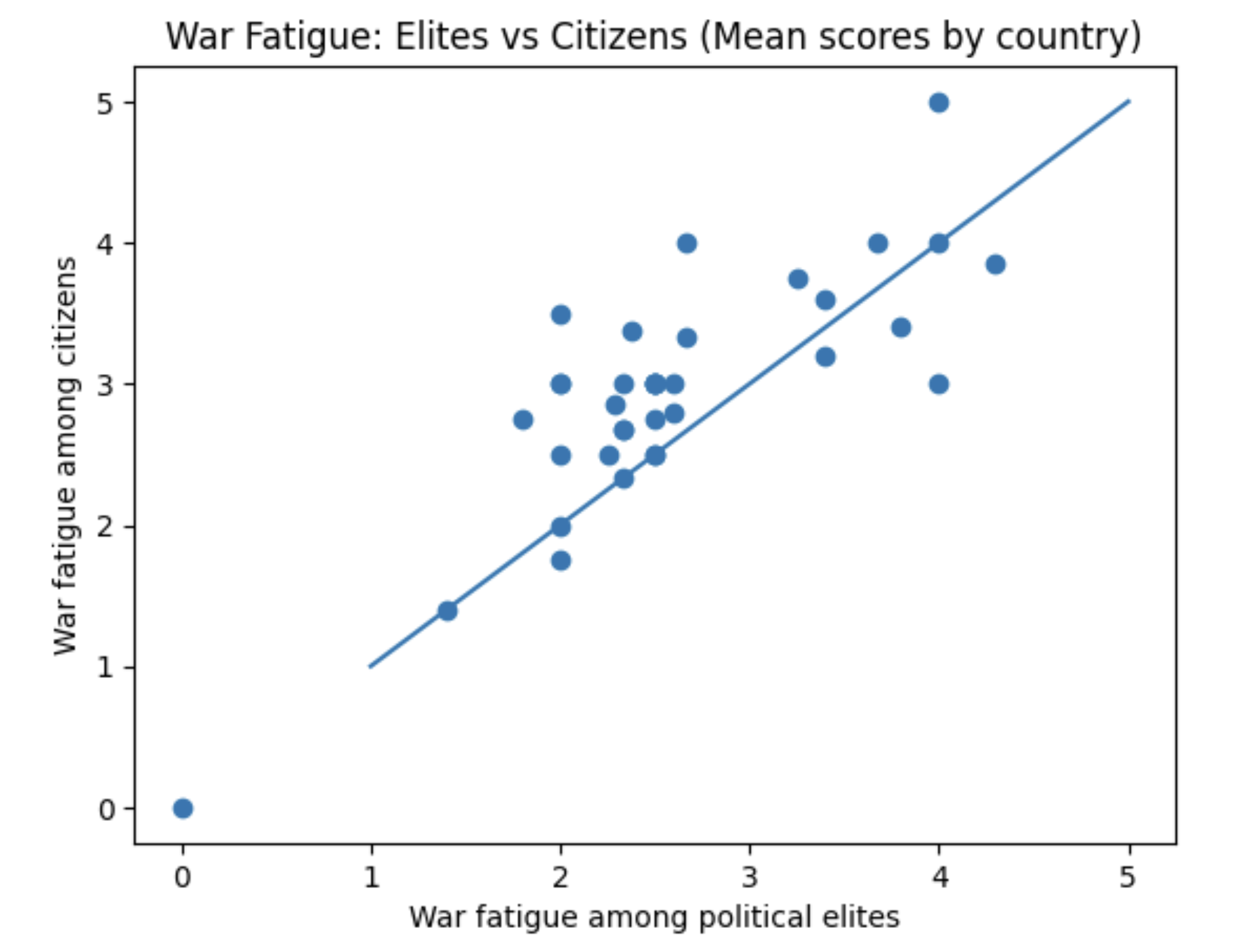
Across countries, one pattern stands out immediately. War fatigue is consistently higher among citizens than among political elites. This gap appears in nearly all cases, suggesting that while decision-makers remain comparatively resilient, public support shows more frequent signs of exhaustion. On the five-point scale, most countries cluster between around “occasionally” (3), indicating that war fatigue is no longer marginal. Rather, it has become a recurrent phenomenon across much of the Western world.
Among political elites, fatigue tends to remain more limited, though not absent (mean: 2,70). In many Western and Northern European countries, expert assessments place elite fatigue below or around the midpoint of the scale, pointing to only occasional signs of exhaustion among decision-makers. At the same time, higher levels of elite fatigue are visible in parts of Central, Eastern, and Southeastern Europe. In some of these countries, mean values approach or exceed the level associated with frequent fatigue, suggesting that even among political elites the prolonged nature of the conflict can take toll. Outside Europe, elite fatigue tends to remain low to moderate and rarely reaches high-frequency levels.
The picture looks notably different when turning to citizens and the wider public. Here, war fatigue is clearly more pronounced, with the mean value being 3,04 (occasionally). In several cases, however, public fatigue reaches the upper end of the scale, pointing to substantial weariness with the war and its consequences in some countries. Only a small number of countries still display more moderate levels of public fatigue, and these remain the exception rather than the rule. Inflation, energy insecurity, pressures related to refugee reception, and the absence of a clear end horizon all contribute to a sense of exhaustion among citizens. While initial solidarity with Ukraine was strong, sustaining that support over time starts becoming increasingly challenging.
If interested, you can find more discussions on the war fatigue in the Special Issue: War Fatigue and the Politicisation of the Ukraine War, published in Journal of European Integration: