Expert insights on democracy, human rights, EU policies & global influence.
Tune in & stay informed.
Latest Episodes:
Does the EU Still Have Normative Power? Rethinking Europe in a Time of Crisis with Prof. Ian Manners
What does it mean for the European Union to have “normative power” in today’s world, and does that idea still hold?
In this episode recorded in February 2026, Professor Ian Manners revisits the concept he famously coined and reflects on how the EU’s global role is being reshaped in a time of overlapping crises.
Drawing on his latest research, this conversation explores new ways of understanding Europe, from his concept of European Communion to his work on planetary politics and the idea of a “planetary organic crisis” - a convergence of inequality, injustice, ecological breakdown, and insecurity shaping global affairs.
Ian invites us to rethink Europe beyond traditional notions of power, and to consider how the EU might act ethically, collectively, and credibly in an increasingly complex world.
Key Topics Covered:
Does the concept of “normative power” still apply in 2026?
The idea of European Communion and what it means for solidarity and integration
Understanding today’s planetary crisis and the EU’s role within it
Critiques of EU “double standards” from global actors like Russia and China
What the EU could look like by 2033
For links to Ian’s research and additional resources, check the full podcast description on SoundCloud, YouTube, Spotify, Apple Podcasts, or your preferred platform now!
Gender Backlash & Democratic Values: Lessons from Latin America for Europe with Dr. Magdalena Provis
In this episode, we explore the growing global backlash against gender equality and democratic values, and what Europe can learn from developments in Latin America and the Caribbean. From anti-gender ideology campaigns to the strategic use of religion in politics, coordinated efforts to roll back women’s and LGBTIQ+ rights are reshaping democratic spaces across regions.
We are joined by Dr. Magdalena Provis Ramírez, Executive Coordinator of the Observatory on Gender Backlash in Latin America and the Caribbean. Drawing on the Observatory’s work monitoring policies, media narratives, and institutional developments across the region, Magdalena explains how anti-gender movements are organised, how they influence political agendas, and what lessons their analysis offers for European actors working on democracy and human rights.
Key Topics Covered:
Why the Observatory on Gender Backlash was created
How anti-gender movements operate across Latin America and Europe
What EU institutions can learn from policy-tracking and monitoring tools
Building stronger EU–Latin America partnerships on gender equality
Opportunities for collaboration with civil society, universities, and policymakers
At a time of democratic backsliding and global polarisation, this episode asks: how can feminist and democratic networks work together to resist coordinated backlash and strengthen shared values?
Be sure to check out their website to learn more and to see how you can get involved.
Browse more episodes of the European Dialogue:
-
![A graphic for the EU-VALUES Network titled 'The European Dialogue,' featuring flags of the European Union flying outside a modern building with glass windows, and a circular inset photo of Jacint Jordana, a middle-aged man with glasses and curly hair, smiling.]()
1st Episode, August 2024: In this special pilot episode, Prof. Jacint Jordana introduces the EU-Values Network, offering an inside look at its mission, development, and future vision.
We explore the network’s origins, the core themes it addresses, including democracy, rule of law, and fundamental rights, and how it responds to the EU’s evolving challenges. Prof. Jordana also highlights the network’s diverse membership across disciplines and countries, and its commitment to fostering collaboration between scholars, institutions, and policymakers. Listen now to learn how the EU-Values Network connects research and practice in shaping the EU’s democratic future.
-
![GeopoliticalEuropeanUnion. Wartime Assistance to Ukraine. Podcast Episode.]()
Sept 2024: In this episode, Prof. Elisabeth Johansson-Nogués discusses the EU’s shifting foreign policy during the Ukraine war.
Based on her research Geopolitical EU? The EU's Wartime Assistance to Ukraine (JCMS, 2024), co-authored with Francesca Leso, this discussion examines the EU’s response, the defense of its core values, and the challenges ahead.
Listen now to understand more about how the war in Ukraine is transforming EU foreign policy, the EU’s evolving role in global security & defense, beyond military aid: defending democracy, sovereignty & human rights and the future of IR in a post-war Europe. Can the EU solidify itself as a true geopolitical power?
-
![Populism, powerplays, poltics in european union. podcast.]()
October 2024:Based on their article Unpolitics: The Role of Populist Governments in EU Decision-Making (Politics and Governance, 2024), Profs. Ariadna Ripoll Servent and Natascha Zaun explain “unpolitics”—a populist strategy that rejects compromise to rally domestic voters.
Using refugee distribution as a case study, they explore how populist governments often prioritize vote-seeking over consensus-building, and where this strategy is most likely to emerge. The conversation also delves into how unpolitics challenges EU decision-making and reshapes populist-citizen dynamics. Listen now to understand the evolving strategies of populist actors and their implications for EU governance.
-
![Chasing Equality, the gender evolution in the European Union]()
November 2024: Drawing on her article Chasing gender equality norms: the robustness of sexual and reproductive health and rights, co-authored with Diego Badell (Sage Journals, 2022), Prof. Esther Barbé explores the EU’s evolving gender agenda.
From the 1957 Treaty of Rome to today’s gender strategies, she traces how the EU has shifted from focusing on equal pay to promoting gender equality as a tool for growth, inclusion, and violence prevention. We discuss global milestones like CEDAW, anti-gender movements, and how the EU can safeguard progress ahead of its 2025 Gender Strategy. Listen now for a critical perspective on gender, power, and policy in Europe.
-
![Right Wing Populism]()
December 2024: This episode features Prof. Daphne Halikiopoulou, discussing right-wing populism in Europe based on her article with Prof. Tim Vlandas, Understanding right‐wing populism and what to do about it? (Wiley IPPR Progressive Review, 2022).
We examine the roots of right-wing populism—from economic insecurity to cultural backlash—and how national histories shape its spread. The discussion highlights key regional patterns and the factors fueling populist party success. Listen now to explore current responses to right-wing populism and the broader challenges facing liberal democracy in Europe.
-
![Strategic Autonomy, European Union, Legal, Rule of Law, Third Countries. Euvalues podacst]()
January 2025: Based on her article Friend Zone Forever? The Essence of and Justifications for the EU's Decision-Making Autonomy? (JCMS, 2023), Prof. Marja-Liisa Öberg analyzes the EU’s strategic stance toward third countries.
We discuss how the EU maintains autonomy in law and policy while managing close relationships with external partners. The conversation explores legal safeguards, external influence, and the balance between cooperation and independence. Tune in to better understand the EU’s “friend zone” dilemma and how it navigates complex global interactions.
-
![Climate Change, Regionalism, Latin America and Europe]()
February 2025:Prof. Andrea Ribeiro Hoffmann joins us to discuss regional climate governance in Latin America, based on the book Climate Change in Regional Perspective (Springer Nature, 2024), co-edited with Profs. Paula Sandrin and Yannis E. Doukas.
We examine why MERCOSUR and UNASUR struggle to advance climate action, the role of political transitions, and how global frameworks like the Paris Agreement intersect with regional efforts. The episode also reflects on COP29 outcomes and anticipates COP30 in Brazil, including civil society engagement and the future of the EU-MERCOSUR deal. Listen now for insights into Latin America’s climate diplomacy.
-
![EU enlargement, politics, geopolitics in Europe, European Union. Podcast]()
March 2025: This episode features Prof. Veronica Anghel on the geopolitics of EU enlargement, drawing on two recent articles co-authored with Prof. Erik Jones: Three Lessons from the 2004 'Big Bang' Enlargement (Politics and Governance, 2024) and The Geopolitics of EU Enlargement: From Club to Commons (Survival, 2024).
We examine enlargement as a strategic tool for peace, how Russia’s actions influence accession candidates like Ukraine and Moldova, and the delicate balance between security imperatives and democratic reform. Recorded just before the 2025 U.S. presidential transition, the discussion also considers transatlantic shifts and the importance of academic-policy-civil society collaboration. Listen now for a timely exploration of how global dynamics are reshaping the future of the EU.
-
![Member states, rule of law, legal, law, podcast]()
April 2025: In this episode, Gisela Hernández discusses the future of EU rule of law enforcement, drawing on two recent articles co-authored with Prof. Carlos Closa: Turning assertive? EU rule of law enforcement in the aftermath of the war in Ukraine (West European Politics, 2023) and Unravelling National Governments’ Positions on EU Rule of Law Enforcement (Journal of European Public Policy, 2025).
We explore how the war in Ukraine, domestic politics, and ideological divides are reshaping EU democracy. The conversation covers Hungary’s resistance to enforcement, the influence of party politics, and how shifting geopolitical dynamics affect compliance and EU unity. Listen now for a deep dive into the political and institutional challenges facing the EU’s rule of law agenda.
-
![Cover image for a podcast episode titled "Who Leads in Cyberspace? Democratic Values and the EU-US Digital Future". The background features a digital circuit with a neon blue padlock icon. The episode features Emily in conversation with Elaine Fahey, and includes a photo of Elaine Fahey in a circular frame.]()
May 2025: In this episode, Prof. Elaine Fahey talks to the EU-VALUES Network about the fast-evolving landscape of EU–US cybersecurity law and policy, based on her research The evolution of EU–US cybersecurity law and policy: on drivers of convergence’ (Journal of European Integration, 2024) and Democratic Leadership through Transatlantic Cooperation for Trade and Technology Reforms through the EU-US TTC Model (Constitutionalism and Transnational Governance Failures, 2024).
From shifting priorities in digital security to transatlantic tensions and cooperation, we discuss how global governance is being reshaped by technological threats, and by the political responses they provoke.
-
![A promotional graphic for a podcast episode titled 'A Fragile Partnership: Rethinking Turkey-EU Relations'. It features a background of the European Union flag and the Turkish flag, with a microphone icon and sound wave graphics. There is a photograph of a woman with blonde hair, wearing a pearl necklace, on the right side. The text indicates Emily is in conversation with Meltem Müftüler-Baç, and the podcast is part of the EU Values series by Jean Monnet Networks.]()
June 2025: This episode features Prof. Meltem Müftüler-Baç, drawing on her recent paper A Fragile Relationship: Turkey and the European Union Moving Beyond Membership with External Differentiated Integration (2024).
We unpack the evolving and often tense dynamics shaping Turkey’s unique relationship with the EU beyond the traditional membership framework. The conversation explores what “external differentiated integration” means in practice, how Turkey’s selective adoption of EU rules tests European values, and the EU’s attempts to foster reform despite political deadlock. We also examine the role of trade in sustaining ties, compare Turkey’s path with other non-member states, and consider the prospects of this model as a long-term solution.
-
![Philanthropy and democracy]()
July 2025: This episode features Sevda Kilicalp and Nils Luyten from PHILEA: The Philanthropy Europe Association, discussing how democracy in Europe is shifting—and what funders can do to strengthen it. Drawing on insights from their new 2025 Democracy Briefer for Funders and the PHILEA Democracy Network’s work across the EU, they unpack how democratic erosion often unfolds through quiet, legal changes rather than dramatic events.
The conversation explores why philanthropy is essential for protecting civic space, the emotional and socio-economic roots of polarisation, and the loss of trust among younger generations in democratic institutions. We also delve into the challenge of building shared narratives amid Europe’s increasingly fragmented media and political landscape.
-
![Cover image featuring a map of Europe with green showing landmasses and blue water. Text includes 'EU VALUES' at the top, 'The European Dialogue,' and 'Exporting Green Rules: Prof. Radu Mares on the EU Green Deal and Supply Chains.' A photograph of a smiling man in a beige blazer appears in a circular cutout. An illustrated microphone icon and sound wave graphics are also present.]()
August 2025: In this episode, Professor Radu Mares from the Raoul Wallenberg Institute of Human Rights at Lund University unpacks the global implications of the European Green Deal — one of the EU’s most ambitious and transformative policy experiments.
Drawing from his conference paper “Is the EU Green Deal a Regulatory Revolution?”, presented at the EU-VALUES International Conference 2025, Radu explores how the EU may be reshaping global supply chain governance and what this means for fairness, climate ambition, and the Global South.
Listen to understand how the Green Deal operates as a potential “regulatory revolution,” what a “layered smart mix” of EU policies looks like in practice, and how the bloc’s climate leadership could redefine global trade, regulation, and sustainability.
-
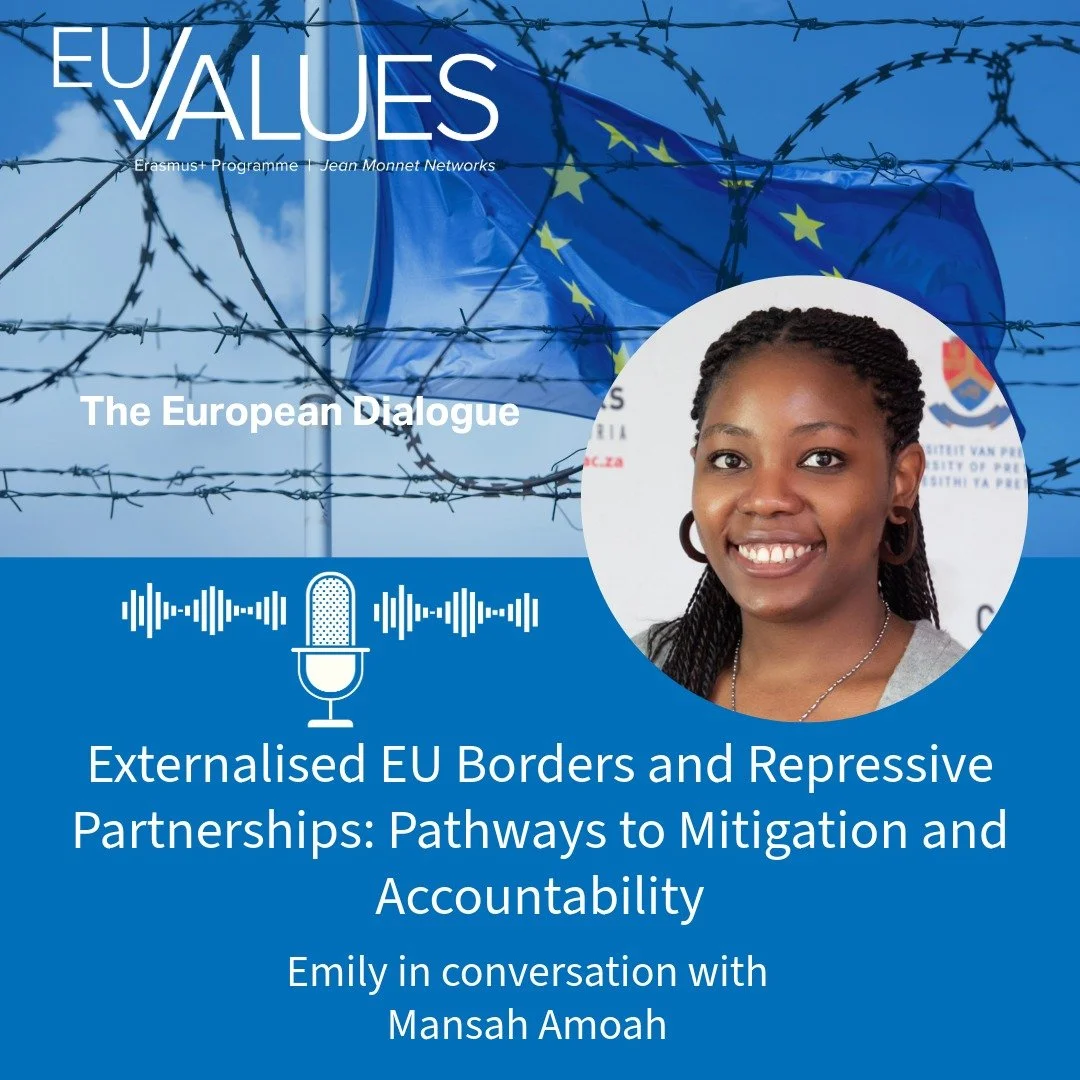
![Podcast cover featuring a blue background with an EU flag and barbed wire, a circular photo of a smiling woman, and text about EU borders and partnerships.]()
September 2025: In this episode, Mansah Amoah from the University of Pretoria examines one of the most pressing and controversial aspects of EU foreign policy — the externalisation of European borders.
Drawing on her doctoral research in law and human rights, Mansah explores how the EU collaborates with African states to manage migration through funding, training, and security cooperation, and what these partnerships mean for governance, accountability, and the rights of migrants.
Listen to learn more about how EU–Africa migration agreements are structured, the human rights consequences of externalised border control, and what pathways to accountability and reform might look like in the EU’s evolving migration governance.
-
![Poster for a European dialogue titled 'Democratic Erosion and European Engagement: Insights from Turkey and Beyond', featuring a photo of Berk Esen, a microphone icon, and a background of a crowd holding Turkish flags at a rally or celebration.]()
October 2025: Dr. Berk Esen, Associate Professor of Political Science at Sabancı University, explores one of the most urgent questions facing Europe today - how European values endure amid accelerating democratic backsliding.
Drawing on his research on party politics, authoritarianism, and democratic erosion, Berk examines how democracy is evolving in Turkey, what parallels and divergences can be seen in the United States, and how Europe’s engagement with countries like Turkey, Hungary, and Serbia reveals ongoing tensions between strategic interests and democratic principles.
For more information and resources - check out the full episode description.
-
![]()
December 2026: Sukmawani Bela Pertiwi, a specialist in Southeast Asian studies and EU–ASEAN relations, explores how ASEAN has evolved beyond its economic foundations and what this means for democracy, human rights, and its partnership with the European Union.
Drawing on her research on regionalism, sovereignty, and political diversity in Southeast Asia, Bela examines how ASEAN’s principles of sovereignty and non-interference shape its political development and external partnerships. She also reflects on how these norms influence the EU’s ability to promote democratic values and human rights in a region where political systems vary widely and state sovereignty remains strongly protected. For more information and resources, check out the full episode description.
-
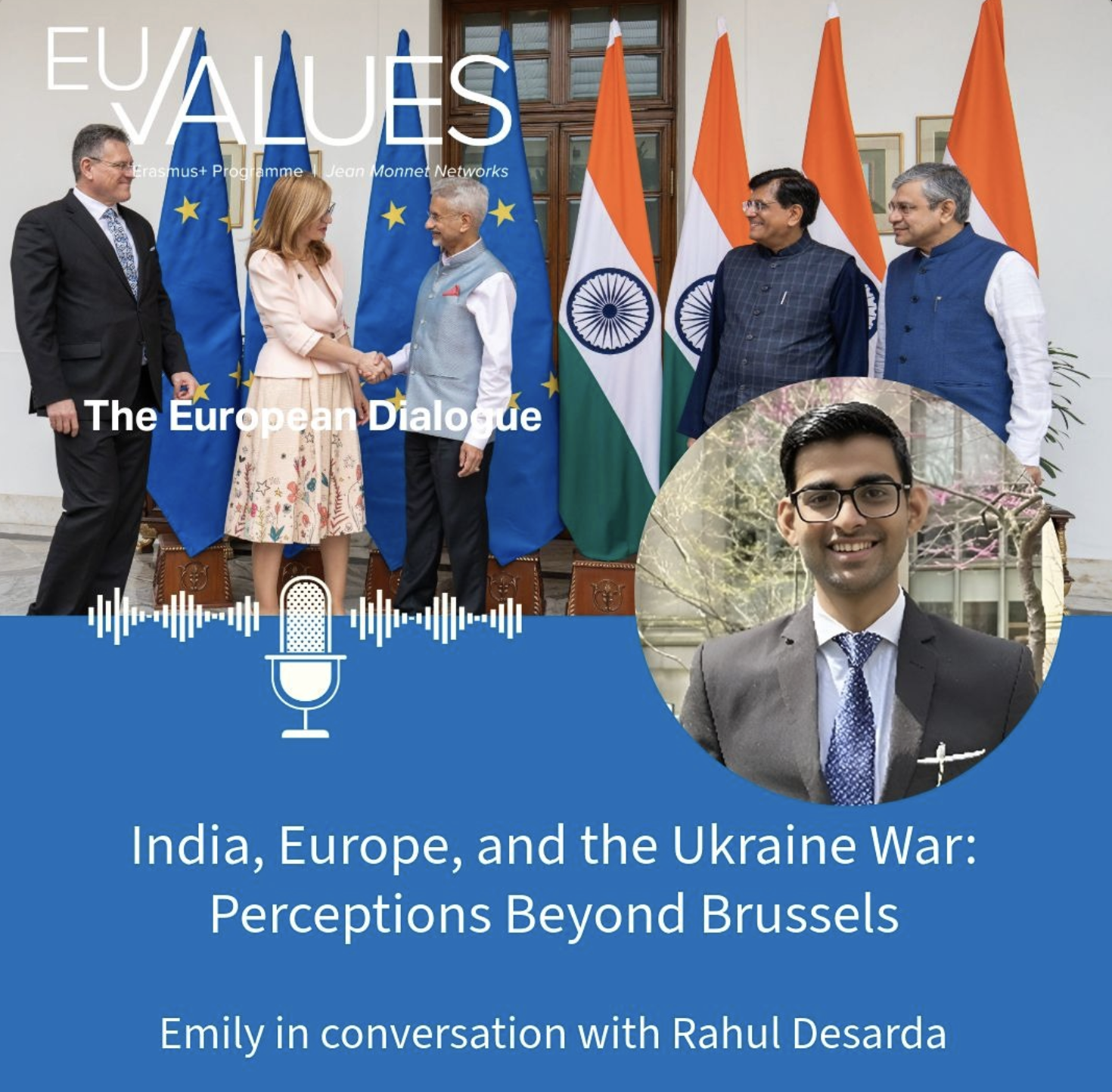
![]()
January 2025: Rahul Desarda, Assistant Lecturer at Jindal Global Law School and Assistant Director of the Mahatma Gandhi Centre for Peace Studies, explores how the European Union’s response to Russia’s war against Ukraine is perceived from India and across the Global South.
Drawing on his research in international law and peace studies, Rahul examines India’s position on the war and situates it within a broader foreign policy shaped by strategic autonomy and multipolarity. He also reflects on how perspectives from the Global South challenge Europe’s value-based foreign policy, particularly regarding sanctions, military support, and multilateral engagement, and what this means for the EU’s global credibility today.