
The downgrading of wolf protection in the European Union: a symptom of a wider pattern
The EU – through its institutions and representatives – often emphasises its commitment to values in the pursuit of its foreign policy objectives, drawing on the laudable but broad provisions of the Treaties – such as the sustainable development of the Earth, the protection of human rights, and peace and security. Yet in practice, it has roughly managed to develop a framework for action that allows to reconcile these values with its legitimate interests. The absence of such a coherent and shared framework prevents the EU from effectively addressing inevitable trade-offs, such as whether and how to engage with strategically important but non-democratic countries with poor human rights records. In practice, the Union frequently resolves these dilemmas in ways that appear inconsistent and hypocritical in the eyes of internal constituencies and external actors. This is best illustrated by the contrast between the EU’s values-based response to Russia’s invasion of Ukraine, and the restrained response to the US intervention in Venezuela to oust Maduro.
The EU’s ambivalent approach to reconciling conflicting values and interests is evident in both its external and internal affairs and across various policy fields. This blog post explores a telling example of these dynamics: the EU’s shifting stance towards the conservation and protection of one of the main large carnivores it houses – the wolf.
Wolf protection and the far-right turn
The wolf has long been protected in the European Union under the 1992 Habitats Directive, which classified it – until recently – as a species “in need of strict protection”. The Habitats Directive is closely linked to the 1979 Bern Convention, an international legal instrument dedicated to the conservation of wild flora and fauna and their natural habitats in Europe and Africa. The signatories to the Convention include the European Union, all of its Member States, as well as the Member States of the Council of Europe, Belarus, Burkina Faso, Morocco, Senegal and Tunisia.
Altering the wolf’s protection status under the Directive is not possible without first amending the Bern Convention.
In 2023, the European Commission introduced a proposal to downgrade the wolf's protection status from “strictly protected” to “protected”. To that end, it first proposed revising the Bern Convention. With the Convention effectively amended by December 2024, the Habitats Directive was amended in June 2025, following favourable votes in both the Parliament and the Council.
On the one hand, the Council backed the downgrade by 24 votes, with only 3 states – Belgium, Spain and Poland – abstaining. On the other hand, the European Parliament approved the proposal with 371 votes in favour, 162 against and 37 abstentions. The vote revealed an ideological divide, with support for the proposal being particularly strong among far-right and right-wing groups: 77% of ECR members, 82% of Patriots for Europe members and 85% of Europe of Sovereign Nations members supported the modification of the wolf’s status. While left-wing groups either abstained or opposed the proposal, the other groups were more divided: within the S&D, 30% of MEPs voted in favour, compared with 61% in the EPP and 63% in Renew Europe.
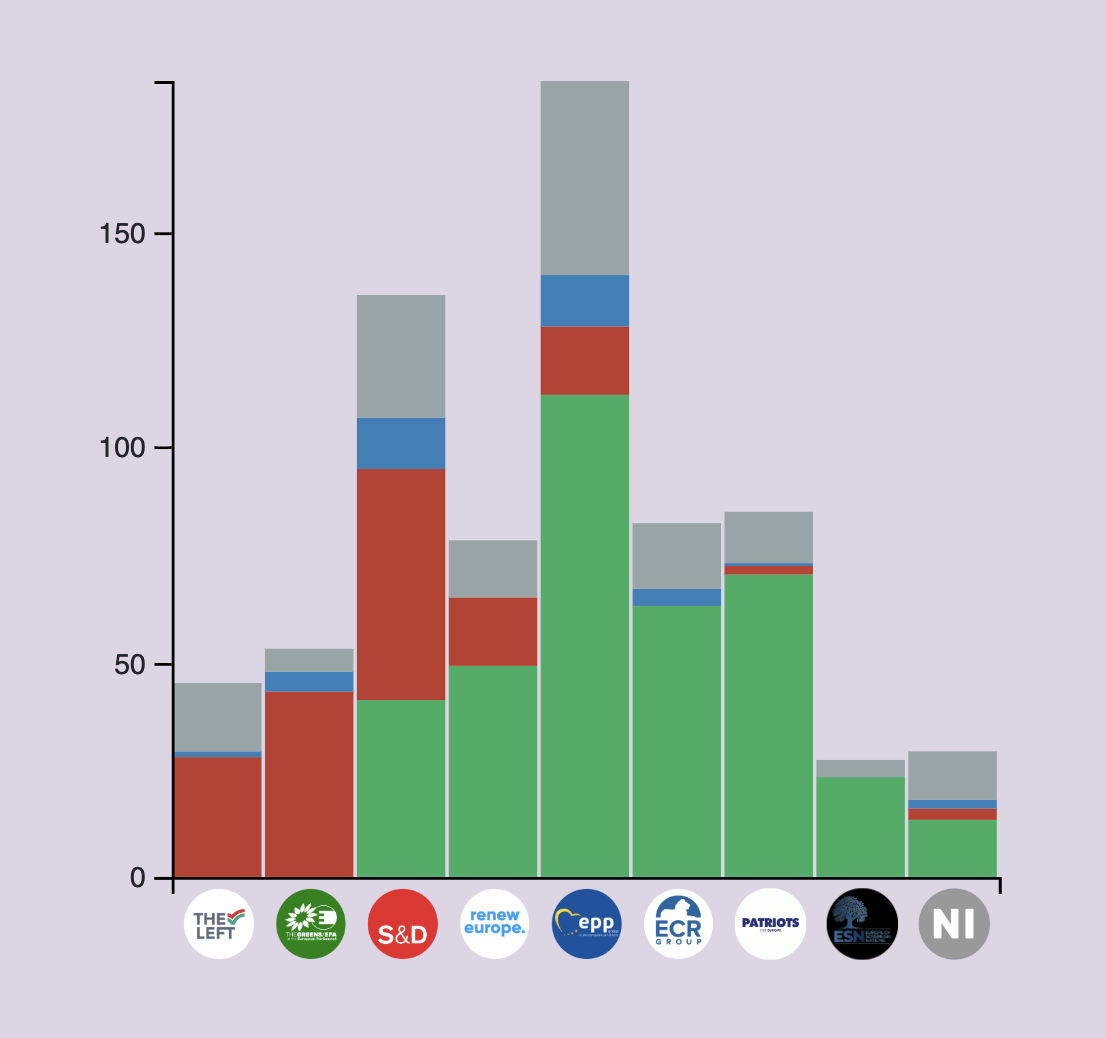
Source: MEP Watch and European Parliament (2025)
Concerns regarding the consultation process
Prior to launching the proposal, the Commission conducted a stakeholder consultation through a dedicated email address, rather than through the usual ‘have your say’ portal, thereby limiting access to results and transparency. The consultation was open from 4 September 2023 to 22 September 2023 – a total of 19 days.
At present, the only publicly available outcome of the consultation is contained in the 2023 report by Blanco and Sundseth, according to which over 70% of the respondents expressed their support for maintaining wolf protection status, while 29% favoured reducing it.
In September 2024, in response to a complaint, the European Ombudsman opened an inquiry into the way the Commission had carried out the targeted data collection. The inquiry was closed in September 2025 due to an ongoing procedure before the European Court of Justice in which the same issues are being examined.
When one of the authors of this post requested access to the consultation contributions, the Commission responded that the data had been destroyed.
The consideration of scientific evidence in the wolf protection debate
In 2023, following a report on the status of the wolf by Blanco and Sundseth (2023), the European Commission decided to issue a proposal to change the wolf’s protection status, allowing for the use of more aggressive tactics to protect livestock from wolf attacks (including lethal actions).
The cited report did not reach conclusions that would unequivocally justify such measure. In fact, it noted that the growing presence of the wolf is bringing important and positive changes to biodiversity, including helping to prevent diseases such as tuberculosis and African swine fever among livestock. Additionally, while it acknowledged an increase in livestock deaths, it also observed that the aggregate impact of wolves on livestock is “very small” even if pressure is sometimes high in certain local areas.
This assessment is supported by available data. The Large Carnivore Initiative for Europe (2023) and Blanco and Sundseth (2023) estimate that the EU’s wolf population is at approximately 21,600 and 20,350, respectively. Considering that, in 2024, the EU had 132 million pigs, 72 million bovine animals, 70 million sheep and 10 million goats (Eurostat, 2025), and that wolves caused 65,499 livestock deaths between 2019 and 2023 (Blanco and Sundseth, 2023), the proportion of livestock losses attributable to wolves appears minimal. Indeed, wolf depredation accounts for 0.065% of annual sheep deaths (Blanco and Sundseth, 2023). Moreover, no human casualties have been recorded during the 21st century.
Accordingly, the Commission’s chosen solution – namely, the modification of status – is not self-evident, and alternative approaches could have been considered.
Effective resource allocation and compensation schemes
As one of the wealthiest regions in the world, the EU is particularly well placed to manage wolf coexistence, including through more efficient compensations for livestock losses, better reconciling environmental and agricultural needs.
In April 2025, the total compensation paid for livestock losses reached €18,698,158 (Large Carnivore Initiative for Europe, 2025). Not all EU countries have compensation systems for wolf-related damages (20 out of the 24 EU countries with wolf presence do), and compensation schemes vary greatly across countries. In Sweden, for example, the system is based on ex ante incentives such as allowances to purchase protective vests for dogs (Blanco and Sundseth, 2023). By contrast, most countries rely on ex post compensation payments, which have been questioned in the past due to reports of fraudulent claims, high transaction costs, and concerns that they discourage the adoption of preventive measures. Farmers and livestock owners also call for more efficient systems, noting delays in payment, underscoring the difficulty to meet standard proof requirements (the animals’ carcass is often required to prove the wolves’ involvement) and noting that indirect damages are not covered. Therefore, rather than weakening the wolf’s status, the EU could prioritise reforming compensation schemes to make them more effective and accessible.
Double standards
The EU has been (and is) one of the main voices in the international arena to call for the protection and governance of environmental and climate issues, as matters affecting the entire humanity. Yet, it does not always uphold internally the very values it promotes externally.
Article 3(3) TEU states that the Union should aim at “a high level of protection and improvement of the quality of the environment”, with article 11 TFEU adding that “environmental protection requirements must be integrated into the definition and implementation of the Union's policies and activities, in particular with a view to promoting sustainable development”. In fact, the EU declares itself a climate leader and recognises climate change, environmental degradation, biodiversity loss and pollution as “existential threats”.
Such pledges are complemented by financial support for conservation efforts beyond the Union’s borders. The Alliance for Wild Fauna and Forests, for instance, was a four-year regional project funded by the EU and implemented in some Latin American countries with the aim to protect endangered species. Other EU initiatives, such as the Global Gateway, also promote the protection of wildlife conservation abroad. For example, the “One Landscape: One Vision” initiative in Liberia seeks to, among others, preserve endangered chimpanzees, hypos and elephants. While these are commendable efforts, the values that underpin them appear to be applied through a double standard as, within the EU itself, biodiversity protections are being weakened.
Conclusion
The EU, a long defender of environmental and biodiversity – as well as of international law, human rights, and democracy – is failing to abide by these values within its own borders, thereby severely undermining its credibility. Its inability, in this instance, to safeguard the environment and protect endangered species exposes a stark tension between stated values and political or economic interests, especially in light of the EU’s pressure on developing countries to implement ambitious, biodiversity‑protective measures.
Although the EU holds a privileged position, due to its considerable economic resources, to craft a balanced approach with regards to wolf protection that effectively reconciles values with practical interests, it is currently struggling to do so. Political polarisation – both within Member States and in the broader geopolitical landscape – has hindered the Union’s capacity to adopt coherent policies that successfully reconcile its values with its practical interests.

Angel Saz‑Carranza is Director of EsadeGeo, Full Professor of Strategy and Policy at Esade, and Visiting Professor at Georgetown University’s McDonough School of Business. He earned a PhD in Public Management from Esade as a Visiting Scholar at Wagner School of Public Service New York University where he spent three years. Previously, he earned a Master’s degree in Aeronautical Engineering from Imperial College, London. A beneficiary of La Caixa and Fulbright scholarships, he was selected as ‘Best 40 under 40 MBA Professors’ by Poets & Quants. He has published over 25 peer-reviewed papers in international business, business–government relations, nonmarket strategy, foresight and scenarios, intergovernmental organizations, and organizational networks.

Laia Serrano i Sorroca is a research and teaching assistant at EsadeGeo - Center for Global Economy and Geopolitics. She holds a Master’s degree in International Security from IBEI and a Master’s in Legal Practice from UOC. She holds a Double Bachelor’s Degree in Law and Global Governance (Esade). At EsadeGeo, she contributes to research projects on the European Union’s foreign and security policy, works on Horizon Europe projects, and assists in the organization of the Esade MBA’s Business, Government and Society course.
The opinions expressed in this blog are solely those of the author and do not reflect the views of EU-VALUES Network.